Three places to listen
Sit at the bench, put microphones close to the strings, or listen from the hall. Widen the stereo image and move the microphones in three dimensions.
A piano, from the inside out
A physically modeled concert grand. Strings that vibrate. Felt that yields. A soundboard that sings. Built from the interaction of its parts.
One-time purchase · Offline license verification
macOS & Windows · VST3 / CLAP / AU / standalone*
Hear it / Play it
Play the piano right here. Every sound comes from our engine, running live on your device.
Computed live in your browser — not samples.
Click Play to hear a note, then use the keys, touch, or your MIDI keyboard. Audio starts only when you choose.
J. S. Bach · Clear arpeggiated voicing and per-bar legato pedal, building over the dominant pedal point.
Score: Mutopia Project (public domain).
F. Chopin · A singing right-hand line over soft repeated chords; the stretto climax at f; smorzando to pp.
Score: Mutopia Project (public domain).
F. Chopin · Full-keyboard ff chords and deep bass, then subito p and pp.
Score: Mutopia Project (public domain).
C. Debussy · pp con sordina (una corda), long pedal blends, the peu à peu cresc. and diminuendo molto.
Score: Mutopia Project (public domain).
L. van Beethoven · A familiar pp melody with its left-hand arpeggios; fast neighbour-note repetition.
Score: Mutopia Project (public domain).
J. F. F. Burgmüller · Dry staccato at Allegro scherzando tempo: fast repetition, damper action, sf accents.
Score: Mutopia Project (public domain).
Rendered by a pre-release build of the plugin from public-domain score MIDI, with a rule-based performance (dynamics from the score's markings, voicing and pedaling rules; no human player). “Studio bounce” is the plugin's offline render, used when the DAW tells the plugin it is bouncing offline (checked in REAPER 7.82 for CLAP, VST3 and AU; other DAWs not yet tested). “Live (Eco)” was captured in real time at 256-sample buffers on the live Eco tier, which is what you hear while playing. Plugin settings are the shipped defaults: reverb off, EQ flat, and the output safety limiter on (−3 dBFS ceiling). After rendering, the only processing is one fixed gain per file, to -20 LUFS with true peak at most -1 dBTP. No other EQ, compression, reverb or editing.
The instrument
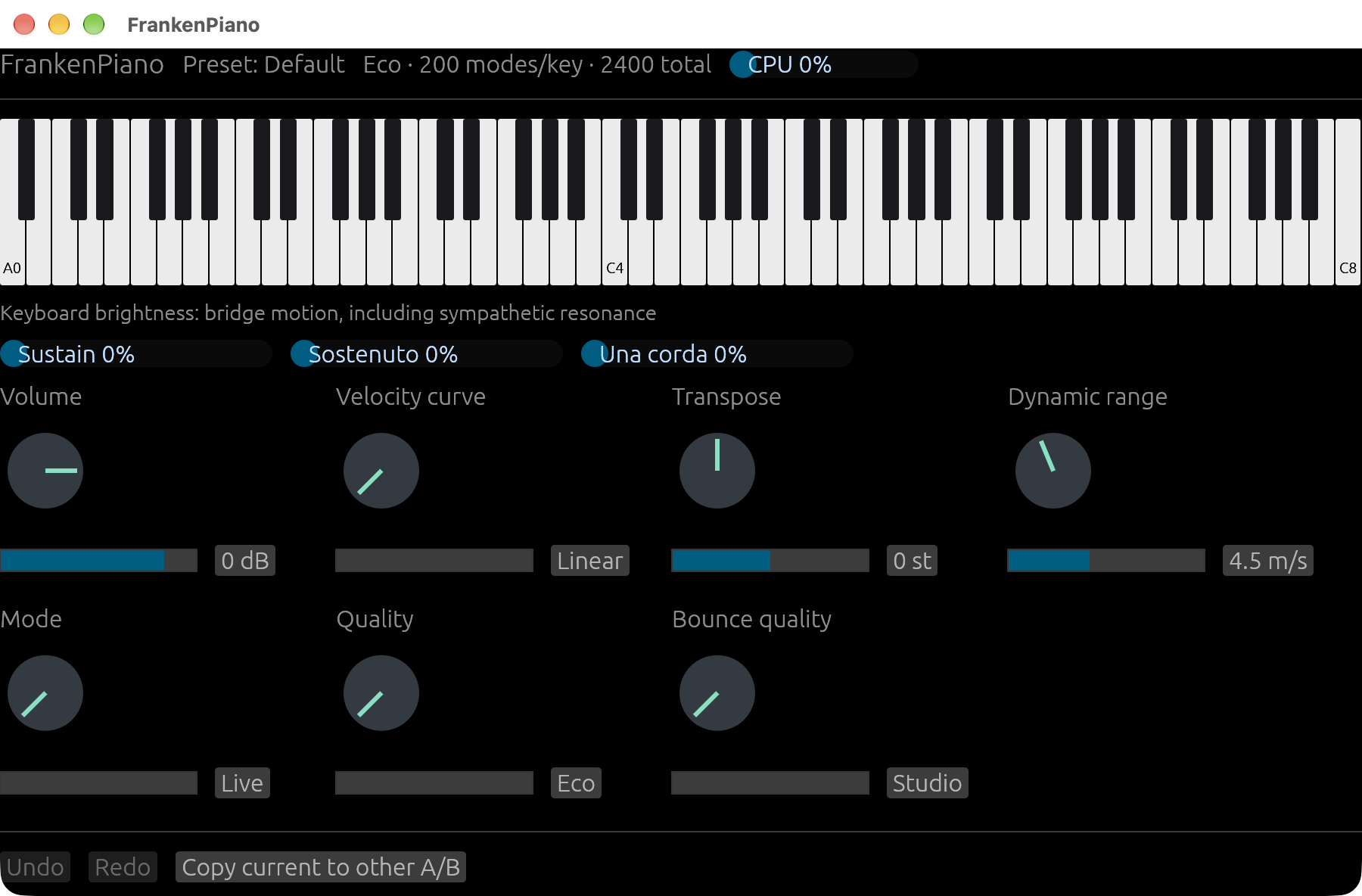
The keyboard lights up with the motion of each string’s bridge. The controls you reach for while playing sit right under it. Everything else is one click away.
The physics story
Built from the bottom up, through the path a note takes from your fingertips into the room.
Coupled vibrating strings give each note its evolving harmonic structure.
A compliant felt hammer transfers energy into the strings through contact.
The bridge carries vibration into a shared, resonant soundboard.
The vibrating board radiates sound into the surrounding air.
Made for making music
Sit at the bench, put microphones close to the strings, or listen from the hall. Widen the stereo image and move the microphones in three dimensions.
Set A4 and the octave stretch, choose from seven historical temperaments on any root, or load your own Scala .scl tuning.
Hammer hardness, string and soundboard damping, unison detune, and an optional shallow-repetition action.
Sustain, sostenuto and una corda. Map any of them, plus volume and dynamic range, to your controller with MIDI learn.
Linear, soft, hard and log-linear velocity curves, a custom three-point curve, or one calibrated from your own playing. Transpose up to three octaves either way.
Five-band EQ, three effect slots (tremolo, wah, chorus, flanger, phaser, fuzz, delay, amp, compressor, EQ), 24 reverb rooms or your own impulse responses, and a safety limiter.
Eco, Balanced and Standard for live playing. When your DAW bounces offline, FrankenPiano renders its Studio model automatically, where every string with its damper lifted rings in sympathy with the notes you play. A Playback mode renders ahead for mixing, with latency compensation.
Twelve factory presets, your own presets and banks, favorites, A/B comparison, and 100 steps of undo.
A metronome with count-in and live chord names. The standalone app plays and records MIDI, exports WAV, and its on-screen keyboard plays with a click.
System requirements
macOS and Windows installer targets. Exact minimum OS versions, processor requirements, memory, and host compatibility will be published after release qualification.
* AU is macOS only. Installers and compatibility are pending release testing; confirm availability before purchasing.
Installation & compatibility →One instrument. Yours.
$50 USD
One-time purchase. No recurring charge.
Applicable taxes are shown at checkout.
Pay by card or PayPal. Signed license and downloads delivered to your email.
A few things to know
FrankenPiano uses physical modeling to generate its sound from the behavior of an instrument’s components.
No. The plugin verifies your signed license locally. The website requires a connection to purchase, sign in and download.
No. It is a one-time purchase with no recurring charge.
Yes. You own your recordings and audio output.
The playable browser demo and the recorded performances above are available now. Installers are still being prepared; check support and download availability before buying.